Two years after my eye surgery there are no side effects. While my
vision is not absolutely perfect it is fine for driving and I have no need
for glasses. My vision before the surgery was...
...in other words pretty bad or severely dependent on glasses. Roughly 20/400 in the right eye and 20/180 in the left with astigmatism in both. After the surgery both eyes are better than 20/40 with no astigmatism. |
||||||||||||
LCA Laser Centers of America
is the company I contacted to do the procedure. I had the procedure done
in Toronto, Canada by Toronto
Laser Sight Center, 1 (800) 243-3937, by Dr. Calvin Breslin.
I picked this doctor because he used the Bausch
& Lomb Surgical Technolas 217 Excimer Laser. After extensive research
on many Ophthalmic Internet sites one fact became completely obvious.
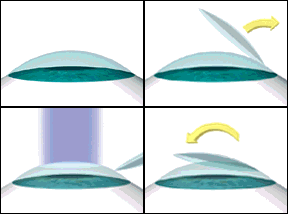
The Technolas 217 Excimer Laser had outstanding results due to the use of a pupil centering software developed initially for the heads up display in military jet fighters. The accuracy of the procedure depends heavily on the precise centering of the laser over the pupil. The other advantage of this system is the use of a strategy of molecular evaporation by the Excimer Laser based on a topological map of the surface of the eye. The most widely used machine in the U.S. implements a fixed power laser and a mechanical iris that results in a series of concentric rings being cut into the cornea. The rings are notorious for producing halos at night. The Technolas 217 directs the laser itself (referred to now as a scanning spot Laser) removing material according the the map. Another critical features is as the Laser approaches it target depth it reduces in power. The reduced power in the final stages results in virtually no inter-cellular heating that can cause scarring. That means that the Laser is actually evaporating single corneal cells while the cells that remains is not exposed to any heat. While the antiquated VisX machine in use in the US uses a mechanical approach the Technolas 217 uses an intelligent approach to polishing the lens from its malformed conical to a perfect spherical shape. The only factors the surgeon contributes to the procedure is his experience with the machine's operation and maintenance and the creation of the LASIK flap. It is best to choose a doctor with the experience of doing hundreds or even thousands of these procedures so he is very familiar with the Laser. Doctors new to the field and eager to get a few procedures under their belt are best left to the unaware victim. I can't recommend having this procedure done only any Laser system other than the Technolas 217 and by anyone other than a very experienced surgeon. Under these circumstances you can have both eyes done at the same time with absolutely no fear and complete confidence in the success of the procedure. The only other factor that significantly influenced the outcome was stupidity on the part of the patient. Every complication could be traced back to something the patient did wrong: rubbing the eyes, taking a shower, going in a swimming pool or some other similar foolishness. The procedure costs approximately $2000 per eye. The cost includes the pre-op evaluation and study. This is where your eye surface is mapped and you are checked for complications. If you are eligible, a visit to the Laser clinic is scheduled. You arrive for the treatment and sit down in the waiting room. There is usually a pile of discarded glasses as a testament to the success of the procedure. A nurse places some drops in your eyes to dilate your pupils. A half hour later you go into the room with the Laser system and lie down on your back. A device is used to keep you from blinking. The only discomfort I felt was that of having my eyes held open. The surgeon washes your eye with saline and then starts the procedure. A device comes down and touches the surface of the eye and applies suction to flatten the cornea. A Keritome makes the LASIK flap and retracts. The surgeon moves the micron thick flap out of the way. The system waits for you pupil to center under the laser and fires. If you look away it stops and waits for re-alignment. There is a sound like hands clapping. If you listen you will hear the laser reduce in power. The laser fires about five to ten times. Each time the surgeon dowses the eyes with saline. The entire process for both eyes takes about five minutes. You sit up and immediately can see clearly! I couldn't help feeling somewhat awed by the experience. While not a miracle it comes damn close. Next the doctor sits you in a standard ophthalmic examining chair and uses the blue light slit to examine the flap. The doctor inserts a special contact lens to protect the flap. There are no nerve ending in the eye so the procedure is painless. There is an intangible feeling of discomfort and bright light may cause some pain due to the dilated pupil. The next day you return and the bandage contact is removed and you vision checked. That's it. There is usually a one week, one month, six month and a yearly follow up visit with the doctor that did the original pre-op work. Your eyes is remapped. Where before the corneal topology resembled the Rocky mountains now is nothing but a beautiful sphere. |
||||||||||||
| Two years later...
I stop every now and then, and marvel at being able to see clearly. I wake up and can see the alarm clock clearly. Near vision has been improved as well so its easier to see a computer screen although I sit farther away now. I can go swimming without fear of loosing my contacts or not being able to see. When you add up all the money you will spend in the coming years for saline, cleaner, contacts and glasses it is obvious that this is a great investment. Comparing the risk of arising from some complication wearing contacts, broken glasses or from a situation where you are dependent on your glasses with the risk of Laser surgery and there is no contest. Laser surgery is, by far, much safer and cheaper. Why so few people failed to take advantage of this modern day miracle is a great mystery to me. I did have one advantage when deciding to have this surgery done. I wore contacts for ten years and suffered a corneal abrasion from lenses that still had some protein solvent in them while on vacation. I can't begin to describe the hell that put me trough. Perhaps you'll just have to wait until something terrible happens to you related to contacts or glasses before you will seriously consider this procedure. |
||||||||||||
| News...
Bausch & Lomb recently received FDA approval to market its leading Technolas® 217 Laser in the United States. A local site... Robert R. Ditkoff, M.D. |